Chapter 43 — Employment and Unemployment
Cambridge International AS & A Level Economics (9708) · Unit 9.3 · 4th edition coursebook
Learning objectives
- define the meaning of full employment
- explain the difference between equilibrium and disequilibrium unemployment
- explain the difference between voluntary and involuntary unemployment
- define the meaning of the natural rate of unemployment
- explain the determinants of the natural rate of unemployment
- analyse the policy implications of the natural rate of unemployment
- describe patterns and trends in (un)employment
- explain the forms of labour mobility: geographical and occupational
- analyse the factors affecting labour mobility
- evaluate the effectiveness of the policies to reduce unemployment.
Key terms
- full employment
- the level of employment corresponding to where all who wish to work have found jobs, excluding frictional unemployment.
- equilibrium unemployment
- the unemployment which exists when the labour market is in equilibrium. It includes voluntary, frictional and structural unemployment.
- voluntary unemployment
- unemployment that arises when workers are not willing to work at the current wage rate.
- disequilibrium unemployment
- unemployment that arises when the aggregate supply of labour is greater than the aggregate demand for labour at the current wage rate.
- natural rate of unemployment
- the rate of unemployment that exists when the aggregate demand for labour equals the aggregate supply of labour at current wage rate and price level.
- hysteresis
- unemployment causing unemployment due to workers becoming deskilled and demotivated when they are out of work for a long time.
- long-term unemployed
- those who have been unemployed for a year or longer.
- labour mobility
- ability of workers to change where they work and in which occupation.
- occupational mobility of labour
- the ability of workers to move from one occupation to another occupation.
- geographical mobility of labour
- the ability of workers to move to a job in a different location.
43.1Full employment
Full employment is the highest level of employment an economy can sustain. Although it might appear that full employment should correspond to 0% unemployment, in practice this is never the case. At any moment, some people are between jobs — they have just left one job and are searching for the next. Full employment is therefore the level at which everyone willing and able to work at the going wage rate has found a job, excluding this frictional element. Governments may differ in the precise unemployment rate they treat as full employment, but the rate considered consistent with full employment is typically a small single-digit figure rather than zero.
Key concept link — Efficiency and inefficiency
If an economy is operating with full employment, it will be productively efficient and will be producing on its production possibility curve.
43.2Equilibrium and disequilibrium unemployment
Equilibrium unemployment exists when the aggregate demand for labour equals the aggregate supply of labour. At that point there is no pressure for the real wage rate to change. Everyone willing and able to work at the going wage has a job. Even so, some members of the labour force remain unemployed — because they are unwilling to accept jobs at the current wage, because they lack information about vacancies, because they do not have the skills or qualifications needed, or because they cannot move to where the work is.
On a diagram, the labour market in equilibrium has aggregate demand for labour (ADL) meeting aggregate supply of labour (ASL) at a real wage rate W (see Figure 43.3). The aggregate labour force (ALF) curve sits to the right of the ASL curve and represents all those who are part of the labour force — including those between jobs, those searching for better-paid work, and those who lack the skills or location to take the jobs on offer. The ALF curve moves closer to ASL as the wage rate rises because more of the labour force become willing to accept work at a higher wage. At the equilibrium wage W, the gap between ASL and ALF represents equilibrium unemployment, which is made up of voluntary, frictional and structural unemployment — caused by supply-side factors rather than by deficient aggregate demand.
Keynesian economists argue that the labour market can be in disequilibrium for long periods. If aggregate demand for labour falls but the real wage rate does not adjust down — because workers resist wage cuts, trade unions hold the line, or a national minimum wage prevents the fall — then the supply of labour exceeds demand at the prevailing wage and involuntary unemployment results (see Figure 43.4). This disequilibrium unemployment is equivalent to cyclical unemployment. Simply lowering the wage rate may not solve the problem, because lower wages can reduce aggregate demand and, in turn, reduce the demand for labour, creating a downward spiral. At any moment an economy can experience both kinds of unemployment at once: part of the unemployment is disequilibrium (cyclical) and part is equilibrium (voluntary, frictional, structural) — Figure 43.5 combines both in a single labour market diagram.
Key concept link — Time
Disequilibrium unemployment can last a long time if workers resist wage cuts or of a wage reduction leads to a further fall in aggregate demand.
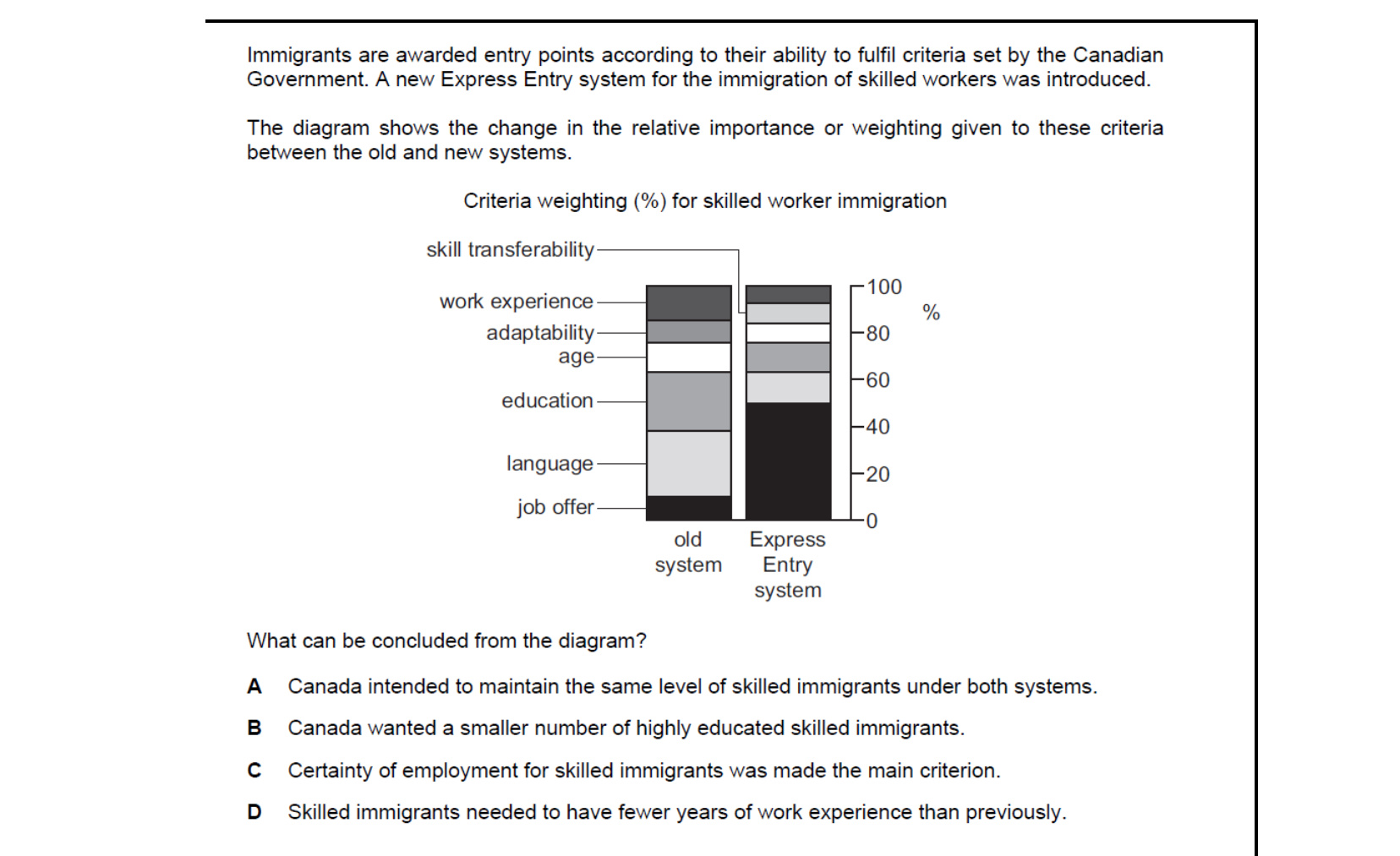
Equilibrium (natural) unemployment is the level of joblessness that remains when the aggregate labour market is in balance — the aggregate demand for labour equals the aggregate supply of labour at the going real wage. Frictional, structural and seasonal unemployment make up this 'no-pressure-on-wages' total, which is what option C identifies.
43.3Voluntary and involuntary unemployment
Voluntary unemployment occurs when workers choose not to accept jobs at the current wage rate. They could be employed but prefer to remain unemployed until they can find a higher-paid job. Involuntary unemployment, by contrast, arises when workers are willing to work at the going wage but cannot find a job.
Most structural and cyclical unemployment is involuntary. Some frictional unemployment — especially search unemployment — may be voluntary, as workers extend their search for a better-paid job, particularly if the available wage is close to or below any unemployment benefit on offer.
In practice it can be difficult to tell whether unemployment is voluntary or involuntary. Those receiving unemployment benefit are unlikely to admit they could get a job. It is also hard to say whether a top scientist who has just lost her job should be classified as unemployed if there is a job as a street cleaner available — the formal availability of any job does not mean it is a realistic option.
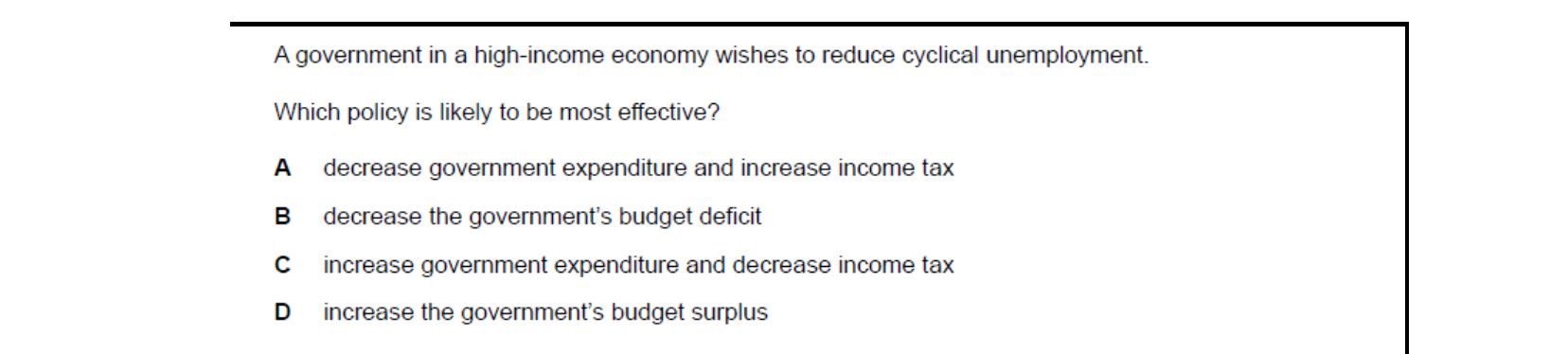
Cyclical unemployment is caused by deficient aggregate demand. Expansionary fiscal policy — increase government expenditure and decrease income tax (option C) — raises aggregate demand, lifts output and so reduces cyclical unemployment. The other options all reduce aggregate demand and would worsen, not reduce, this type of unemployment.
43.4The natural rate of unemployment
The natural rate of unemployment exists when the labour market is in equilibrium — aggregate demand for labour equals aggregate supply of labour. The concept goes a step further than equilibrium unemployment by adding a long-run idea: it is the rate to which new classical economists believe the economy will return in the long run and which is consistent with a constant inflation rate. If a government tries to push unemployment below this rate by increasing aggregate demand, aggregate demand for labour rises and pushes the wage up, but in the long run higher costs raise the price level, the real wage falls back and unemployment returns to the natural rate.
The factors that determine the natural rate of unemployment are supply-side factors — those that cause voluntary, frictional and structural unemployment. They include:
- the value of unemployment benefits relative to the value of low pay
- national minimum wage legislation
- the quality of education and training
- how workers are affected by periods of unemployment
- the quantity and quality of information about job vacancies and workers' skills and qualifications
- the degree of labour mobility
- the flexibility of workers and firms.
Policy implications of the natural rate of unemployment
To reduce the natural rate of unemployment, a government will seek to increase both the willingness and the ability of workers to work at the current wage rate. The main policy approaches include:
- Widening the gap between low pay and unemployment benefit. Cutting unemployment benefit or the basic rate of income tax raises the reward from working relative to the reward from not working.
- Removing restrictions on what firms can pay. Some economists argue that firms are less likely to cut jobs if they can cut wages instead — and that a national minimum wage prevents this.
- Improving education and training. A more skilled labour force finds it easier to switch between occupations and so suffers less structural unemployment. Training of the unemployed is particularly important in tackling hysteresis — the long-term unemployed lose confidence, their skills become out of date and firms are reluctant to hire them.
- Increasing the quantity and quality of labour-market information. Better information about vacancies and about workers' skills reduces frictional unemployment.
- Improving labour mobility. When workers are more mobile, vacancies are more easily matched with the unemployed.
- Increasing flexibility in the labour force. New classical economists favour reducing the power of trade unions and removing minimum wage legislation, on the grounds that both can hold the wage above the equilibrium level. Greater flexibility on the part of firms — over working hours and the location of work — can also raise the number of workers willing to accept jobs at the current wage.
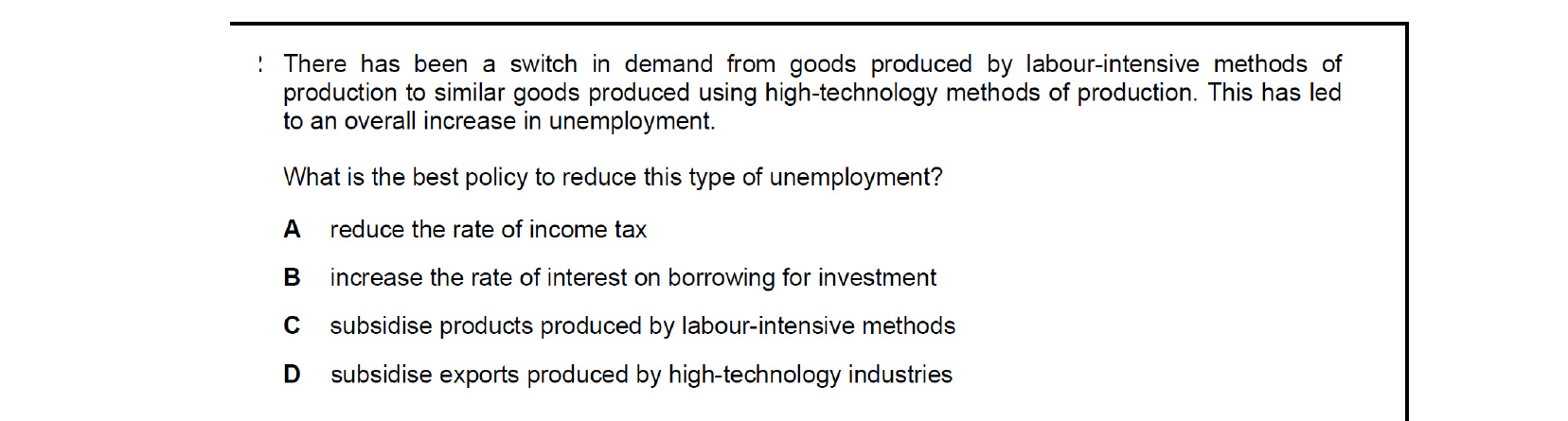
The unemployment described is structural — workers with labour-intensive skills are displaced as demand shifts to high-technology methods. Subsidising the products still produced by labour-intensive methods (option C) supports demand for those workers, slowing the structural shift and reducing their unemployment more directly than general demand or interest-rate measures.
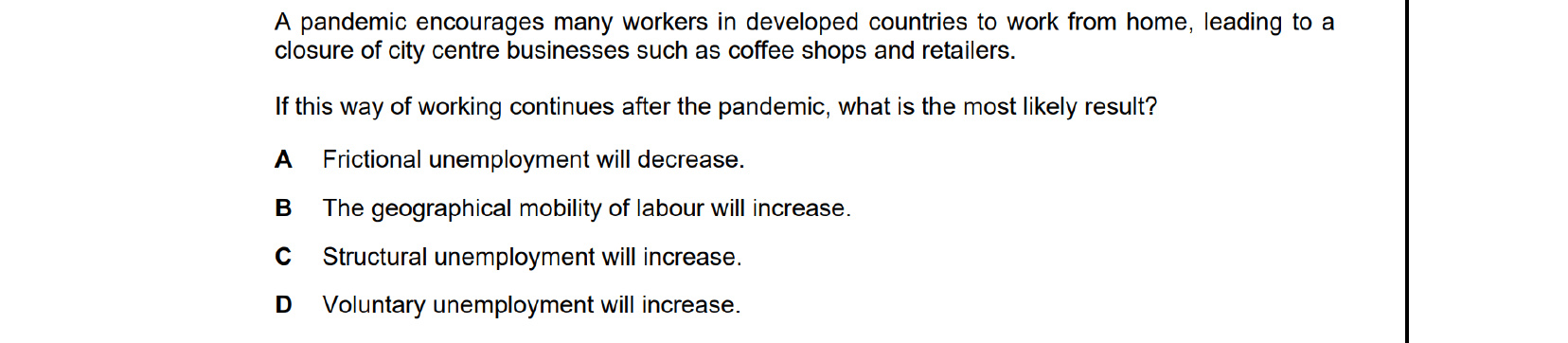
When the pattern of demand permanently shifts away from city-centre coffee shops and retailers, the workers there have skills tied to the old industries and the wrong location for new vacancies. The resulting mismatch between worker skills/location and the new structure of demand is structural unemployment (option C).
43.5Patterns and trends in unemployment
Unemployment is rarely evenly spread. It tends to be higher in declining industries and in declining occupations. It can also vary noticeably between regions of the same country — differences in transport links, infrastructure and housing costs all play a role.
In most countries unemployment is higher among young workers. Firms may be reluctant to hire them because of their lack of experience and the cost of training. Certain groups — including women, people with health conditions or impairments and those from ethnic minorities — may experience discrimination in the labour market and face an above-average unemployment rate.
An upward trend in the unemployment rate and in the number of unemployed people will worry any government, but the duration of unemployment matters as much as the level. If those who are unemployed stay out of work for a long time they may lose the work habit and develop long-term unemployment — and so face hysteresis, with their skills atrophying and employers increasingly unwilling to take them on.
Key concept link — The role of government and the issues of equality and equity
Governments usually seek to keep unemployment as low as possible. This is not only because they want to increase efficiency but also because they want to increase equality and equity. The pain of unemployment is not evenly spread. Some groups, including young workers, have a greater than average chance of experiencing unemployment.
43.6Patterns and trends in employment
The pattern of employment varies between countries, although there are some similarities in trends. It can be examined in a number of ways, looking at how workers are distributed across sectors, contract types, the formal/informal divide and between the public and private sectors. The dimensions matter for living standards, productivity and the appropriate policy response, because each form of employment carries different protections, pay and job security.
- Industrial structure. As many countries have developed, employment has moved first from the primary sector to the secondary sector and then on to the tertiary sector. Low-income economies still typically have most of their labour force in primary activities such as agriculture, with smaller shares in manufacturing and services. High-income economies have most of their workforce in services, a small share in manufacturing and very little in primary production. This structural shift reflects rising productivity in primary and secondary activities, shifts in consumer demand toward services as income rises, and the growth of skill-intensive service industries such as finance, education and health.
- The proportion of women in the labour force. The general trend is for women to form an increasing proportion of a country's labour force. There are a number of reasons why more women are working and seeking work: a rise in the pay women can receive, more job opportunities, increases in the qualifications women are gaining, greater provision of childcare and a reduction in gender discrimination. Higher female participation also raises the productive capacity of the economy and the long-run supply of labour.
- Employed and self-employed. Most people work for someone else. They have an employer who decides, for example, the hours they work and the tasks they perform. However, an increasing proportion of workers are self-employed — a former teacher might set up as an educational consultant advising schools on how to improve their performance, for instance. Self-employment offers flexibility and autonomy but also greater income risk and fewer entitlements to sickness pay, paid leave or employer pension contributions.
- Full-time and part-time. The proportion of people who work full-time and part-time varies over time. Some people choose to work part-time so that they can help to raise their children, care for elderly or sick relatives or enjoy leisure activities. Others are forced to work part-time as full-time jobs are not available — this is most likely to occur during an economic downturn, when involuntary part-time work and underemployment rise.
- Employment in the formal and informal economy. Workers in the formal economy are protected by employment legislation, but those in the informal economy are not covered by, for example, national minimum wage legislation, restrictions on working hours and health and safety standards. Those in the informal economy are not represented by trade unions and are unlikely to receive sickness benefit or a pension. The informal sector is particularly large in many low- and lower-middle-income economies, and the absence of protections leaves these workers vulnerable to exploitation and old-age poverty.
- Secure and insecure employment. In a number of countries there has recently been a growth in insecure employment. More workers are being employed in the gig economy. These workers often do not know how many hours they will work the following week. Like workers in the informal economy, gig workers do not receive sickness benefit or a pension. Some workers like the ability to choose when and where they work; others only do this work because they cannot find secure employment. Such workers may find this type of work quite stressful because of the uncertainty involved. The unreliability of their income may also mean that they experience difficulty buying or renting a home.
- Private and public sector employment. The relative quality and availability of private- and public-sector employment varies from country to country. In some countries, working for the government has high prestige and high pay; in others, the proportion of workers employed in the private sector has increased with privatisation. The balance between the two sectors influences the average level of pay, the spread of wages across the labour force and the security of employment.
Key concept link — Progress and development
High-quality employment which provides high pay, good working conditions and job security increases living standards.
43.7The forms of labour mobility
Labour mobility is the ability of workers to move from one occupation to another or from one location to another. There are two main forms.
Occupational mobility is the ability to move between jobs of different kinds. Some moves are easier than others: an accountant retraining as a teacher of accounts faces a smaller jump than a gardener retraining as a software engineer.
Geographical mobility is the ability to move to a job in a different location. There may be unemployed workers in one part of the country and vacancies — for which those workers have the right skills — in another part of the country or another country altogether, but if the unemployed cannot move, the vacancies stay unfilled.
Factors affecting occupational mobility
- Quality of education and training. Better-educated, better-trained workers can do a wider range of jobs.
- Information available. Workers need to know where the new opportunities are if they are to move smoothly from declining to expanding occupations.
- Barriers to entry and exit. Professional bodies and trade unions may restrict entry to an occupation to drive up the wage rate. Long-term contracts can also lock workers into a particular occupation.
- Time. The longer the period, the more opportunity workers have to gain the training, qualifications and skills needed for a new occupation.
Factors affecting geographical mobility
- The price and availability of housing. A lack of affordable housing in areas where the jobs are can prevent workers from moving.
- Information available. As with occupational mobility, workers need to know where vacancies are and the pay and conditions on offer.
- Personal ties. Workers may be reluctant to leave family and friends to move to another location.
Movement between countries involves additional factors:
- Immigration controls — limits on work visas and permission to stay can restrict cross-border movement.
- Language barriers — workers may not be able to take up jobs in countries whose language they do not speak.
- Cultural differences — workers may find the culture of another country unattractive.
- Differences in pay and the cost of living — workers may find that they are better off unemployed at home than employed abroad.
43.8Policies to reduce unemployment
To reduce cyclical unemployment, a government will use expansionary fiscal or monetary policy tools to raise aggregate demand. Possible expansionary fiscal tools include:
- a reduction in indirect or direct taxation to raise consumer expenditure
- a cut in corporate taxes to stimulate investment
- an increase in government spending.
Possible monetary tools include:
- reducing the rate of interest to raise consumer expenditure and investment
- increasing the money supply to raise consumer expenditure and investment
- lowering the exchange rate — through a formal devaluation or through intervention in the foreign exchange market in the case of a managed float — to raise net exports.
How much such policies actually increase employment depends on several factors. The rise in aggregate demand may be muted if consumers and firms are worried about the future, or if firms add capacity by buying capital equipment that requires few extra workers to operate. Fiscal and monetary policies also have time lags: by the time unemployment is recognised, policy tools chosen and the policy implemented, other components of aggregate demand may already be picking up — and the stimulus then arrives at the wrong moment.
To reduce frictional and structural unemployment, a government is likely to introduce supply-side policies. It may improve labour-market information, cut unemployment benefit and income tax rates to raise the reward from working, and so encourage people to spend less time between jobs. Better education and training raise occupational mobility and so reduce structural unemployment. Trade union reform may stop unions pushing wages above the equilibrium level and taking industrial action.
Supply-side policies can be slow to act. Workers may not respond as expected. And if the true cause of unemployment is a lack of aggregate demand, supply-side tools may make matters worse — a cut in income tax has the potential to reduce all kinds of unemployment in theory, but in practice it depends on there being jobs to take. If there are no suitable vacancies, cutting unemployment benefit simply reduces consumer spending and so risks worsening cyclical unemployment.
End-of-chapter practice
Past-paper questions from CIE 9708. Pick A, B, C or D. Answers are saved on this device — press Download report (PDF) at the top to save them.
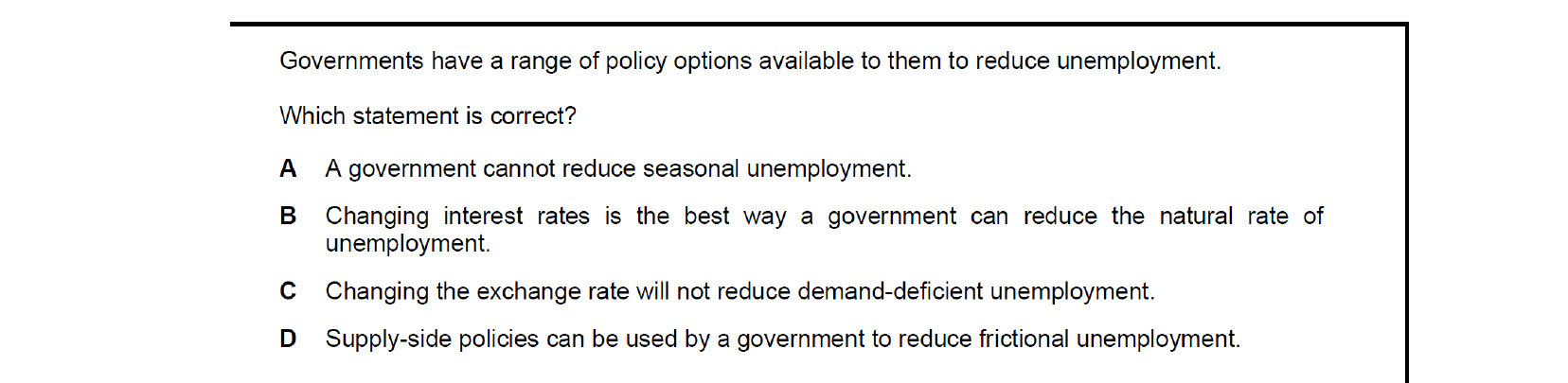
Frictional unemployment arises from the time taken to match workers to jobs. Supply-side policies — better job-search information, retraining, employment agencies — speed up the matching process, so they can be used to reduce frictional unemployment (option D). The other statements are factually wrong.

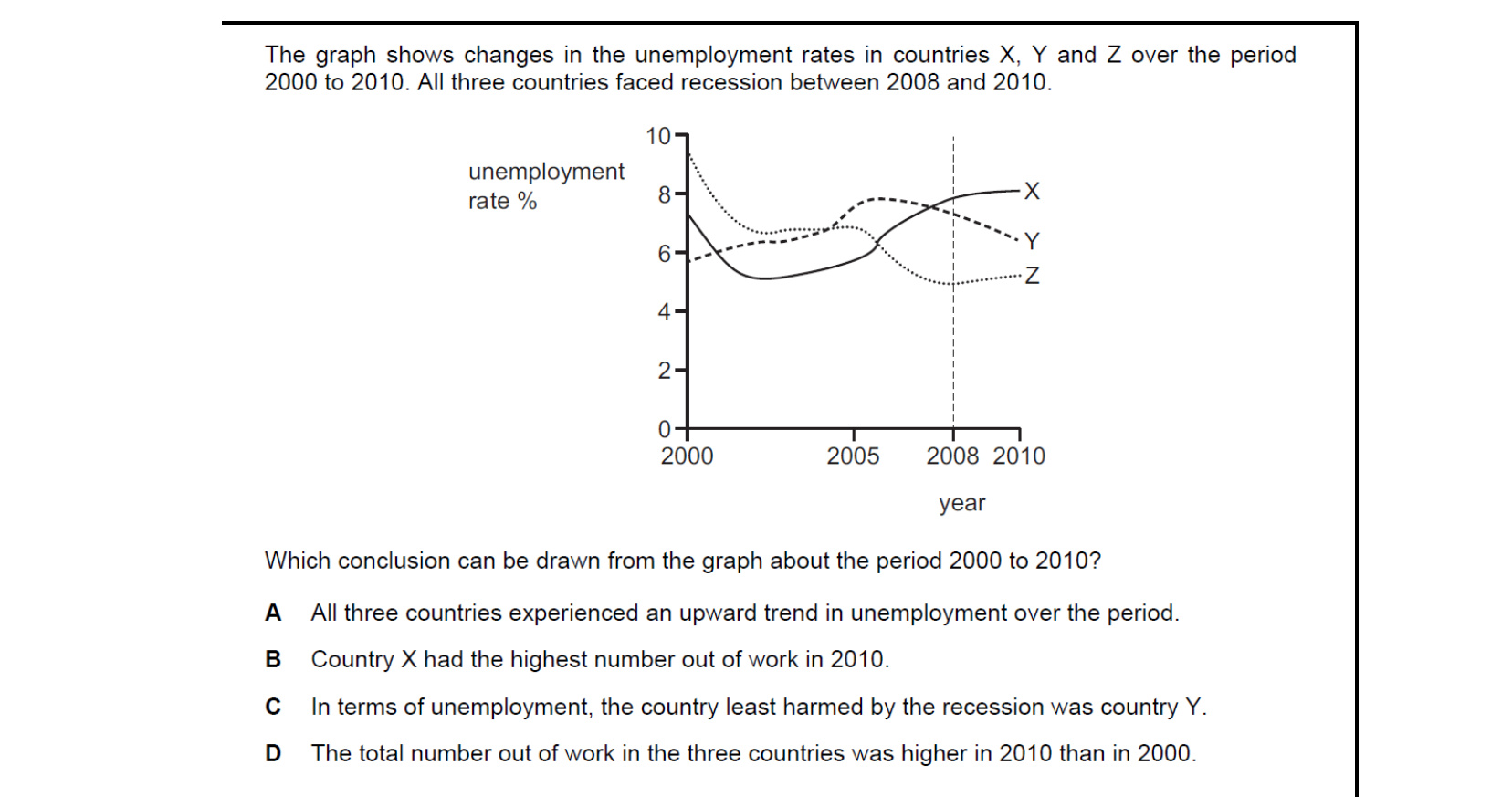
Decreasing unemployment benefits (option B) raises the opportunity cost of remaining jobless and reduces voluntary and frictional unemployment, encouraging workers to accept available vacancies. The other options either reduce aggregate demand or harm competitiveness, both of which would reduce employment, not increase it.
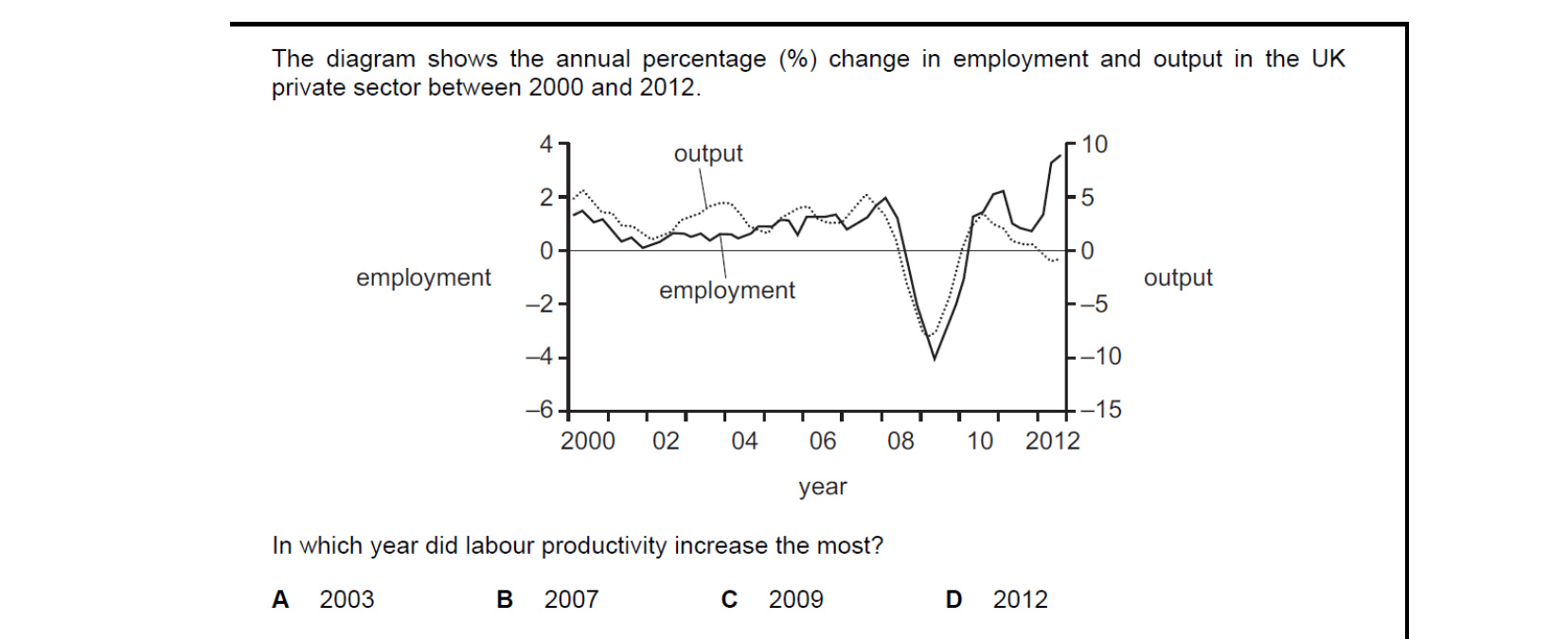
Labour productivity rises fastest in the year where output growth most exceeds employment growth. On the UK graph, 2003 (option A) shows clearly positive output growth combined with low or negative employment growth — output rose substantially with little extra labour input, the largest productivity gain among the four years.
Occupational mobility — workers' ability to move between different jobs — depends on education and training. A fall in the school leaving age (option C) cuts the time pupils spend acquiring transferable skills, reducing their occupational mobility. The other options (more training, better information, more internet access) all raise it.
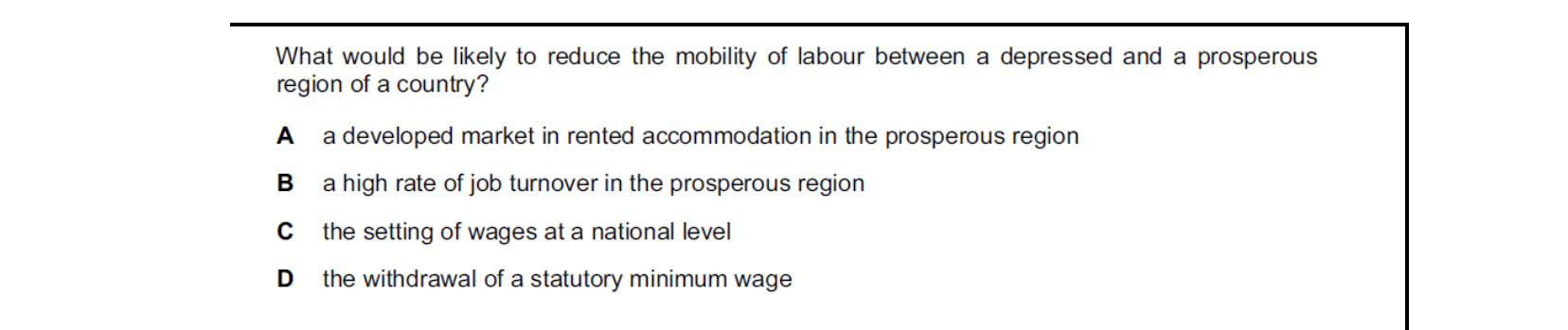
Workers move between regions when wages in prosperous areas exceed those in depressed ones. National wage-setting (option C) eliminates that gap — pay is the same everywhere — so the financial incentive to migrate disappears and labour mobility between regions is reduced. The other options preserve or restore the regional wage differential.

A significant increase in indirect taxes (option B) raises prices, cuts consumers' real disposable income and so reduces aggregate demand. Lower demand for goods means lower derived demand for labour and so higher unemployment. The other options each raise aggregate demand or improve supply-side performance, reducing rather than increasing unemployment.
Attempt the practice questions above to build your score.
Self-evaluation checklist
After studying this chapter, you should be able to:
- Understand that full employment is the highest rate of employment that it is thought the economy can achieve
- Explain that equilibrium unemployment is the unemployment that will exist when the aggregate demand for labour equals the aggregate supply of labour and disequilibrium unemployment occurs when the aggregate supply of labour is greater than the aggregate demand for labour
- Explain the determinants of the natural rate of unemployment: level of unemployment benefit, skills of workers, labour mobility, flexibility of workers
- Analyse the implications of a government's policy approaches and tools to reduce the natural rate of unemployment
- Describe patterns and trends in unemployment/employment in various countries
- Understand that there are two forms of labour mobility: occupational mobility and geographical mobility
- Analyse the factors that influence occupational mobility and geographical mobility
- Evaluate the effectiveness of expansionary fiscal and monetary policies to reduce cyclical unemployment and supply-side policy to reduce frictional unemployment and structural unemployment
Want more practice? Drill this chapter's past-paper MCQs (76 questions) →